Choosing among China’s top Logo In Plastic manufacturers requires more than comparing unit prices. Global buyers need reliable production, clear communication, and consistent quality from the first sample to the final shipment. Plastic logos may look simple, yet small details matter. Surface gloss, edge smoothness, color accuracy, adhesive strength, and dimensional tolerance can affect the finished product.
Experienced sourcing teams usually begin with technical drawings, material requirements, artwork files, and expected order volumes. Reputable manufacturers should explain their capabilities clearly. They may offer injection molding, soft PVC production, 3D emblems, electroplating, printing, or custom adhesive backing. A capable factory should also provide samples before mass production. This step reveals issues that digital proofs often hide.
Look closely.
For global buyers, factory evaluation should include production equipment, inspection procedures, packaging methods, and export experience. Documentation may include material declarations, test reports, and quality records, depending on the product’s market and application. Buyers should confirm whether the supplier can maintain the same color and shape across repeated orders. One attractive sample proves very little.
Cost is important, but the lowest quotation may create hidden expenses. Rework, delayed shipping, weak adhesion, or damaged packaging can quickly reduce savings. I have seen supplier profiles appear convincing while practical details remained vague. That is a useful warning. Good decisions require questions, evidence, and patience.
This guide examines China-based Logo In Plastic manufacturers from a global buyer’s perspective. It focuses on supplier credibility, customization ability, quality control, communication, lead times, and responsible sourcing. The goal is not to promote every manufacturer equally. It is to help buyers compare options carefully and choose partners that can support stable, transparent, and repeatable production.
What Defines a Top Logo-in-Plastic Manufacturer?
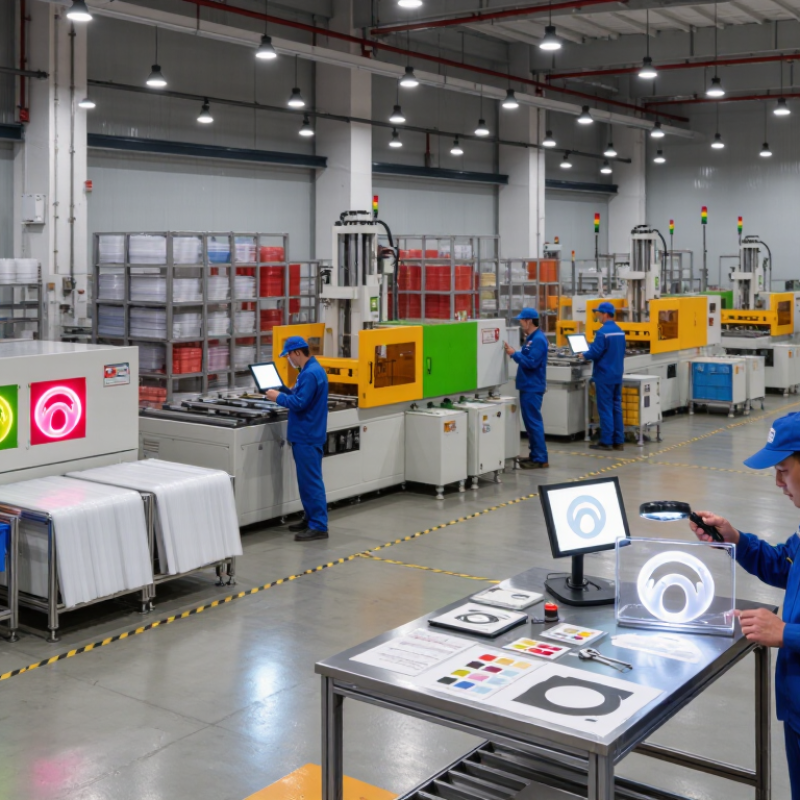
A top logo-in-plastic manufacturer turns artwork into a durable, readable surface detail. The process may involve in-mold labeling, molded inserts, laser texture, or layered plastic decoration. Each method behaves differently under heat, pressure, friction, and cleaning chemicals. Experienced engineers test these conditions before approving production.
Reliable manufacturers control more than appearance. They review resin compatibility, logo depth, color tolerance, mold flow, and edge definition. A clear sample should match the approved drawing under normal factory lighting. Production records should connect each batch with material data, machine settings, inspection results, and operator checks. This traceability helps identify problems instead of hiding them.
A capable supplier also asks practical questions. Will the part flex during assembly? Can workers see the logo from different angles? Will repeated handling dull the finish? Small pilot runs often reveal weaknesses that digital images cannot show. No factory gets every detail right. A trustworthy one admits this early and proposes a measurable correction. Sometimes, a simpler logo structure performs better than a highly detailed design. That may disappoint a buyer, but honest guidance protects the final product. Clear communication, stable quality checks, and documented testing define real manufacturing strength.
Embedding logos in plastic products requires more than attractive artwork. It depends on resin behavior, mold temperature, surface energy, and production volume. PlasticsEurope reported 400.3 million tonnes of global plastics production in 2022, showing the scale of this manufacturing environment.
In-mold labeling places a printed film inside the mold before injection. Heat and pressure bond the label to the part, reducing secondary decoration steps. In-mold decorating can also form durable graphics over curved surfaces. For small logos, pad printing remains flexible, especially on uneven parts. Hot stamping applies metallic or colored foil through controlled heat and pressure. Laser marking creates permanent contrast by changing the surface layer, without ink. Each method needs trials.
Details matter. A logo can blur when the film shifts by only a fraction of a millimeter. Excessive mold heat may distort fine lettering. Weak adhesion can appear after humidity, abrasion, or chemical testing. According to PlasticsEurope, recycled plastics reached 13.2% of European plastics production in 2022, and recycled resins may vary in color and surface consistency. That variation complicates logo matching. No process is flawless. A reliable supplier should record ink batch, film thickness, molding temperature, and inspection results. Industry reports from Smithers also identify decorative plastics as a growing technical field, but production reality is less tidy than forecasts. Human inspection still catches defects that automated cameras sometimes miss.
Typical melt-temperature windows for thermoplastics commonly used with in-mold decoration, molded-in logos, laser marking, pad printing, and hot stamping. Values are representative industry ranges and vary by resin grade, additives, tooling, and processing conditions.
Lower-temperature materials generally provide more flexibility for heat-sensitive films and foils, while higher-temperature materials require compatible decoration layers and carefully controlled molding conditions. Laser marking and post-molding printing avoid exposing the logo substrate to the full melt temperature.
China Top Logo In Plastic Manufacturers for Global Buyers?
Key Industries Served by Logo-in-Plastic Manufacturers
Logo-in-plastic manufacturing supports automotive, consumer electronics, appliances, packaging, and medical equipment. These suppliers use in-mold decoration, insert molding, laser marking, and molded lettering. According to MarketsandMarkets, the global in-mold labels market may grow from about USD 3.2 billion in 2023 to USD 5.1 billion by 2028. That growth reflects stronger demand for durable product identification.
Automotive manufacturers require logos that resist heat, vibration, oils, and repeated cleaning. Interior panels, switches, charging covers, and control knobs often use embedded markings. In consumer electronics, manufacturers prefer thin, precise graphics on housings and control surfaces. The International Energy Agency reported that global electric car sales exceeded 14 million units in 2023. This expansion creates more demand for lightweight, decorated plastic components.
Packaging and home appliances need clear branding with strong abrasion resistance. Food containers, washing-machine panels, and small appliance housings are common applications. Medical equipment requires stricter control over materials, traceability, and surface cleanliness. ISO 9001-based quality systems help, but certificates alone do not prove consistent production. A logo may look perfect on a sample, then fade during testing. This is where supplier audits, adhesion tests, color checks, and batch records matter. The process is not flawless. Buyers should question attractive samples and request evidence from real production conditions.
| Key Industry Served | Typical Logo-in-Plastic Applications | Common Plastic Materials | Preferred Decoration or Identification Method | Important Performance Requirements | Typical Compliance Considerations |
|---|---|---|---|---|---|
| Consumer Electronics | Device housings, control panels, buttons, battery covers, charging accessories and product identification plates | ABS PC PMMA PC/ABS | In-mold decoration, pad printing, laser marking, hot stamping and molded-in raised or recessed lettering | Dimensional stability, scratch resistance, good surface appearance, electrical insulation and heat resistance | RoHS and REACH may apply; electrical products may also require fire-rating evaluation such as UL 94, depending on the assembly |
| Automotive and Transportation | Interior trim, dashboard controls, ventilation components, switch panels, emblems and functional identification marks | PC/ABS PP PA POM TPE | Laser etching, molded-in symbols, pad printing, hot stamping and two-shot molding | UV resistance, temperature cycling, vibration resistance, chemical resistance and long-term adhesion | Automotive material specifications, restricted-substance requirements and flammability testing are commonly reviewed by buyers |
| Medical Devices and Healthcare | Instrument housings, diagnostic equipment controls, disposable device markings, trays and patient-use product identification | PC PP PE ABS TPE | Laser marking, molded-in identification, chemical-resistant printing and high-contrast direct marking | Cleanability, chemical resistance, biocompatibility suitability, legibility and resistance to sterilization processes where applicable | Material traceability, ISO 13485 quality systems and applicable medical-device regulations may be required; suitability depends on the product category |
| Industrial Equipment and Automation | Machine control panels, electrical enclosures, terminal blocks, safety labels, handles and equipment nameplates | ABS PC PA PBT PVC | Pad printing, laser marking, molded-in symbols, embossing and durable adhesive-backed plastic plates | Oil resistance, impact strength, abrasion resistance, dimensional accuracy and clear visual contrast | RoHS, REACH, electrical safety and enclosure-related requirements may be considered according to the equipment and destination market |
| Electrical and Power Products | Switches, sockets, circuit-protection components, cable accessories, meter housings and identification markings | PC PA PBT ABS PVC | Laser marking, molded-in symbols, pad printing and hot stamping | Electrical insulation, flame resistance, heat resistance, tracking resistance and permanent legibility | UL 94 or equivalent flammability testing may be relevant; applicable electrical and restricted-substance standards depend on the finished product |
| Household Appliances | Control knobs, appliance panels, touch-control overlays, handles, filters and molded product information | ABS PP PC PMMA TPE | In-mold decoration, laser engraving, pad printing, screen printing and molded-in lettering | Heat and moisture resistance, detergent resistance, scratch resistance and consistent color or gloss | Electrical safety, RoHS and REACH may apply; food-contact requirements are relevant when the marked component contacts food |
| Packaging and Consumer Goods | Caps, closures, reusable containers, cosmetic packaging components, dispensers and product information panels | PP PE PET PS TPE | In-mold labeling, embossing, debossing, screen printing, hot stamping and molded-in decoration | Print adhesion, moisture resistance, chemical resistance, recyclability considerations and high-volume consistency | Food-contact or cosmetic-packaging requirements may apply; relevant rules vary by product type and destination market |
| Construction and Building Materials | Switch plates, pipe fittings, ventilation controls, door and window hardware, insulation components and installation accessories | PVC ABS PC PA PP | Embossed lettering, molded-in marks, laser marking, pad printing and durable plastic identification plates | UV stability, impact resistance, moisture resistance, dimensional stability and resistance to construction chemicals | Building-product, electrical-safety and fire-performance requirements may apply according to the component and installation environment |
| Telecommunications and Networking | Router housings, network equipment panels, fiber-optic components, cable management parts and port identification marks | ABS PC PC/ABS PBT | Laser marking, pad printing, molded-in symbols and high-contrast in-mold decoration | Flame resistance, dimensional precision, heat dissipation support, abrasion resistance and stable color | RoHS, REACH and applicable electrical or electromagnetic-compatibility requirements may be reviewed for the finished equipment |
| Sports, Outdoor and Recreational Products | Equipment grips, protective housings, helmets and accessories, controls, storage components and product identification marks | ABS PP PC PA TPE | Laser engraving, molded-in graphics, pad printing, embossing and two-shot molding for grip areas | Impact strength, sweat and weather resistance, UV stability, comfortable tactile properties and abrasion resistance | Product-specific safety standards, chemical restrictions and consumer-product testing may apply depending on the intended use |
Global buyers evaluate plastic logo manufacturers through evidence, not polished promises. A capable supplier explains resin selection, molding limits, surface treatments, and color control in plain language. Ask for production samples, not only digital renderings. Inspect edge sharpness, raised lettering, hole placement, and adhesive coverage under normal light. Small defects become obvious on a vehicle panel, appliance door, or retail fixture. The best discussions include tolerances, inspection methods, and realistic output capacity. Fast replies help, but technical clarity matters more.
Quality records reveal consistency. Request pre-production approval samples, batch photos, dimensional reports, and adhesion test results. A reliable manufacturer should identify the resin grade and explain how heat, moisture, and cleaning chemicals may affect the logo. Packaging also deserves attention. Separated layers can prevent scratches during long-distance transport. Ask how rejected pieces are isolated and replaced. This is practical evidence of process control.
Cost still matters, but the lowest quotation can hide tooling changes, weak packaging, or unstable color matching. Compare complete landed costs and lead times. Verify factory experience with similar shapes and finishes, while respecting confidentiality. No supplier is perfect. A minor sample mismatch may expose a larger communication problem. Buyers should record decisions, approve a physical standard, and review performance after delivery. That feedback protects future orders and encourages honest improvement.
China remains a major sourcing base for plastic logo manufacturers, supported by mature tooling, molding, printing, and assembly networks. Grand View Research valued the global plastics market at approximately USD 712.6 billion in 2023. This scale supports competitive production, but not every factory offers the same technical depth.
Southern China is strong in injection molding, electroplating alternatives, pad printing, and rapid tooling. Eastern manufacturing regions often provide better access to engineering teams, export logistics, and material suppliers. Meanwhile, European suppliers usually emphasize premium finishing, traceability, and strict documentation. North American manufacturers often serve shorter regional supply chains and specialized industrial applications.
Capability matters more than location alone. Buyers should request mold-flow analysis, resin certificates, color standards, adhesion tests, and sample approval records. The Smithers report on sustainable packaging identifies recycled content and lightweight design as continuing market priorities. These trends are influencing decorative plastic components too. Suppliers using recycled resin may face color variation or surface defects. That risk needs testing.
Low price is not proof of capability. A factory may quote quickly but lack stable color control. A useful audit checks production samples under daylight, warehouse light, and heat exposure. ISO 9001 certification can support process reliability, although certification does not replace physical inspection. Some suppliers also offer in-mold labeling, laser marking, and automated visual inspection. These services improve consistency, yet small-volume customization may still increase tooling costs and lead times. That trade-off deserves honest review.
Common methods include in-mold labeling, in-mold decorating, pad printing, hot stamping, and laser marking. Each method needs practical trials.
A printed film enters the mold before plastic injection. Heat and pressure bond the film to the finished part. This can reduce extra decoration steps.
Pad printing offers flexibility on uneven or smaller parts. However, alignment and ink adhesion still require testing. Small details can blur.
Hot stamping transfers foil using controlled heat and pressure. It can create metallic or colored effects. Excessive heat may distort fine lettering.
No. Laser marking changes the surface layer to create permanent contrast. The final appearance depends on the plastic’s color and composition.
Film movement, mold temperature, and pressure can affect sharpness. A tiny positional shift may change the logo visibly. Fractions of a millimeter matter.
Request physical samples, dimensional reports, batch photos, and adhesion results. Inspect edges, lettering, holes, and coverage under normal lighting. Digital renderings are not enough.
Test resistance to humidity, abrasion, cleaning chemicals, and temperature changes. Review the logo after each test. One sample may not reveal every weakness.
Recycled resin may vary in color and surface consistency. These differences can affect contrast and finish. A perfect color match is not always realistic.
Approve a physical reference sample before production. Use separated packaging layers to prevent scratches. Record resin grades, temperatures, film thickness, and inspection results. Communication can still fail, so review delivered parts carefully.
A top Logo In Plastic manufacturer combines advanced production technology, consistent quality control, creative design support, and reliable international service. These manufacturers can integrate logos through methods such as in-mold labeling, in-mold decoration, laser marking, embossing, debossing, and multi-material molding. Their expertise helps ensure that logos remain clear, durable, and accurately positioned throughout a product’s service life. They also provide support in material selection, mold development, color matching, prototyping, and large-scale production.
Logo-in-plastic suppliers serve industries including consumer goods, electronics, automotive components, packaging, appliances, tools, and industrial equipment. Global buyers typically evaluate suppliers by examining production capacity, quality certifications, communication efficiency, sampling speed, customization capability, pricing transparency, and delivery reliability. Leading manufacturing regions offer different strengths, from advanced automation and engineering expertise to flexible production and cost efficiency. The best supplier is one that balances technical capability, dependable quality, responsive service, and scalable manufacturing for long-term international cooperation.

Yuanzhong Printing